
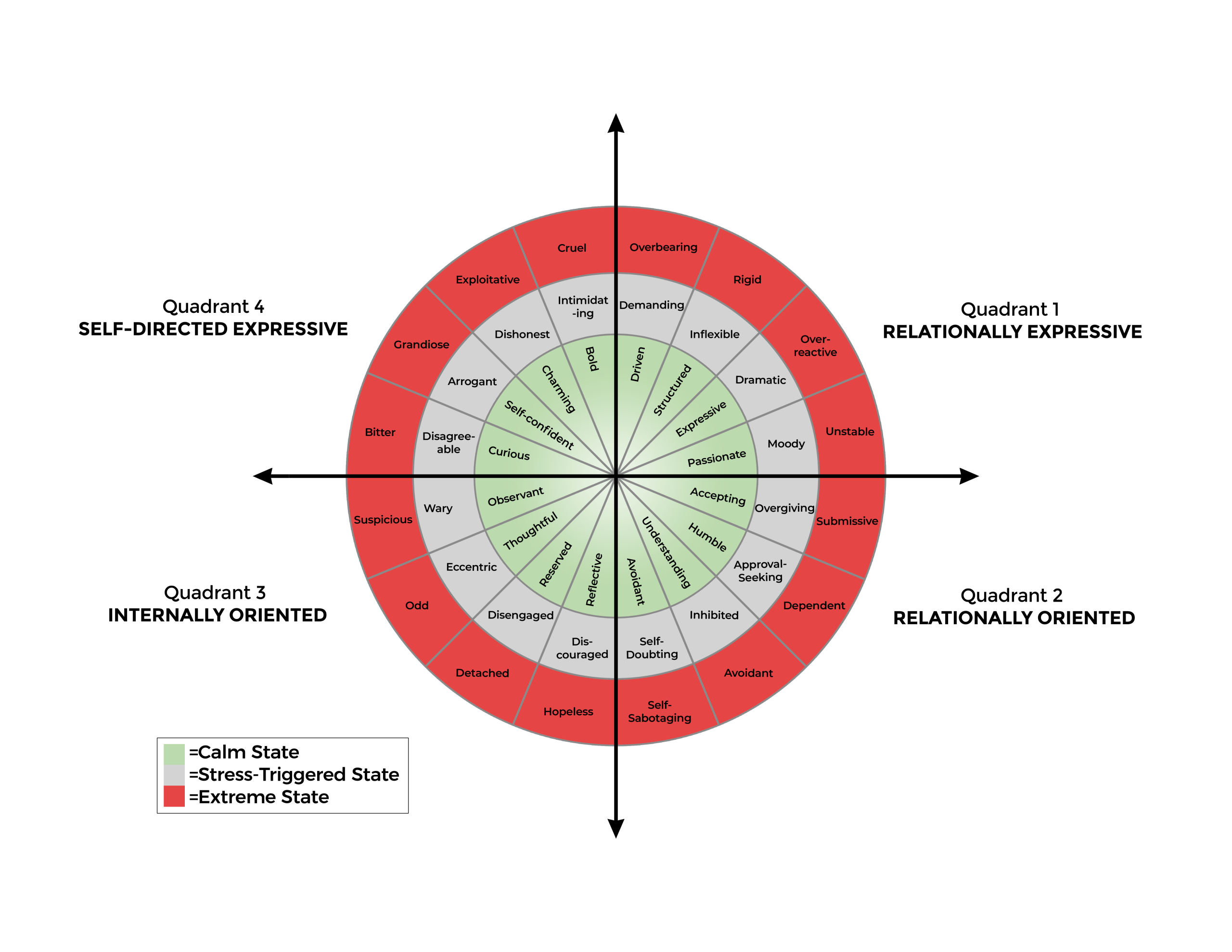
The InnerScience Personality Wheel
The InnerScience Personality Wheel helps explain something most teams have seen happen:
Someone reacts in a way that surprises everyone — including the individual.
The same pattern shows up again. A manager says “let’s handle this differently next time”… and next time looks the same. The InnerScience Personality Report helps explain why.
It reveals how each person functions in their calm state — the version of them that feels natural, effective, and in control.
It also reveals how they function under moderate stress (their stress-triggered state) and high stress (their extreme state).
These insights help your team understand not just why someone does what they do, but why they keep doing it. With that knowledge, you can build teams, coaching and/or support that leads to real change.
Real personality insights. Real change. Real growth.
Understanding the InnerScience Personality Wheel
The Personality Wheel is built on 2 axes:
Vertical: Driven vs. Reserved — How expressive someone tends to be. This ranges from assertive and energetic to thoughtful and cautious.
Horizontal: Self-Focused vs. Others-Focused — What motivates someone. This ranges from autonomy and self-reliance to connection and collaboration.
Together, these axes form 4 quadrants:
- Quadrant I – Relationally Expressive
Enthusiastic, energetic, expressive, socially engaged.
- Quadrant II – Relationally Oriented
Kind, humble, patient, emotionally sensitive.
- Quadrant III – Internally Oriented
Thoughtful, realistic, grounded, risk-averse.
- Quadrant IV – Self-Directed Expressive
Bold, focused, analytical, self-reliant.
It’s important to note, each quadrant is a normal, healthy way of engaging with work and life. In addition to each quadrant helping to give insight into an individual’s personality, there are also four distinct personality types with each quadrant— 16 adaptive styles in total.
The wheel also has 3 different zones based on your stress state:
- Green Zone: Your calm state — the version of you that feels most like you. Life and stressors feel manageable here, and as a result, your personality traits show up as strengths.
- Gray Zone: Your stress-triggered state. Here, stress is starting to build, regulatory systems feel “under pressure,” and actions may become more reactive. Consequently, relationships feel harder, and everyday decisions feel heavier.
- Red Zone: Your extreme state, reached when stress builds without relief. In other words, this is regulatory collapse — feeling emotionally flooded or shutting down. As a result, actions no longer reflect your values.
That said, the goal isn’t to keep every team member permanently in the Green Zone, because stress is a natural part of all work. Instead, the goal is awareness: recognizing the early signs of a shift, so your team can respond with intention instead of reacting from overwhelm.